
+38 5362 3 22 04
7:30-16:30 on working days
+38 050 403 08 45
Vodafone + Viber
office@mehzavod.com.ua
Write to us
Beater (additional cleaning of sunflower hulls)
(1 goods)
Sort:
default
Beater (additional cleaning of sunflower hulls)
The beater separator is designed to separate the pancake of dust from the husk of sunflower. The product is installed in Rosalina-winnowing departments of the mills. Also, after certain modifications (replacement of the screens, change the frequency of rotation of the rotor and drum, etc.), it is possible to use the machine for sifting meal, cleaning wheat
Specifications
|
Performance on the husk, t/d |
40,0* |
|
Installed capacity, kW main drive screw |
15,0 1,1 |
|
Rotation frequency, rpm of the rotor drum screw |
620 20 75 |
|
The inner diameter of the beater, mm |
420 |
|
The length of the beater, mm |
3200 |
|
Reducing the oil content of husk, %, not more not less than |
0,5** 0,2** |
|
The frequency of the purge of the Sith, with |
20...60 |
|
Requirements compressed air: working pressure, MPa consumption, l/min |
0,5...0,6 120...130 |
|
Overall dimensions, mm, not more: length width height |
4100 880 2100 |
|
Weight, kg |
1770 |
*Possible short-term increase in productivity (throughput) up to 45 MT/day by reducing the quality indicators of the machine.
**Reduction of oil content depends on the initial moisture (optimum moisture content of husk 10-11% moisture sunflower 6,8-7,2%). At lower humidity, respectively, decreases the rate of removal of oil content. Also, as a result of peculiarities in the design of the machine designed more for removal of oleaginous dust, is inefficient selection of whole and pieces of kernels, one dimensions greater than 2.5 mm, which greatly increase the overall oil content of the product (should be possible to remove them in the tech chain to the beater-separator).
Differences from the counterpart in the technological scheme
Reliability:
Maintenance and maintainability:
applied more lifting bearings of the drum, which increases their service life,
increased stiffness of the shaft of the auger;
Package contents:
the increased diameter of the window in the sidewall of the primary actuator for the replacement of cuffs of the bearings without complete disassembly of the beater,
reduced weight of the tumbler screening cylinders – easier manual replacement,
the pneumatic cylinder taken out to the outside of the machine from the working area;
Improved ergonomics and aesthetic appeal of the machine.
the package introduced chain flap on the intake pipe
the control panel comes bundled with the machine;
The structure and operation
The machine consists of the following main parts: a housing 1, a beater 2, a basket 3, the screw 4, the device bootable 5, conveyor 6, the nozzles 7 and download upload 8, doors 9, valve 10, the actuator 11 and 12, the chain tensioner 13, a cleaning system 14, rails 15 and 16 (Fig.1 and Fig. 2).
In the housing 1 is the main body of the machine, the beater 2. It consists of a rotor with whips 17, which is mounted in bearing assemblies secured on the end walls of the machine housing 1 and the drum 18, which in turn is mounted in bearing assemblies mounted on the rotor shaft. Thus different frequency of rotation of the rotor and the drum. The rotation of the rotor is the main drive through V-belt transmission. To drive use the standard foot motors of an output of 15.0 kW. The tension of V-belts 19 is made using the tension screws 20. The rotation of the drum is driven via V-belt, reducer 21, chain drive 22. The tension of V-belts 23 is produced by tensioning screws 24. The chain tension using the tensioner 13. The body 1 also has the screw in bearing units, mounted on the end walls. Rotation of the auger is through the gear motor. The product enters through the inlet nozzle 7, the device boot 5 into the working area where the pests reported both rotational and axial movement. Due to the intense strike in the gaps between the sieve and rotor is the destruction of the product and subsequent separation of the oil mass, which is discharged by the auger. Using gonkov on the rotor husk moves through the unloading device and the outlet is discharged from the machine.
Attention! If for some reason you need to replace one of the beach on the rotor 17, it is necessary to replace also the opposite beach. If possible, it is recommended to replace complete set. After replacing the whips, the rotor must be balanced.
The drum 18 (Fig. 2A) consists of an input 25, the output 26 and the sieve drums, connected in a vertical plane, sieve in turn from the two frames 27 and 28, connected in the horizontal plane, attached to them a replaceable sieve. For a correct disassembly of the sieve cylinder, you must begin with the dismantling of the part 27 from the product download. To facilitate disassembly of the bearing assemblies in the housings have threaded holes for the clutch cover bolts. A simplified procedure for dismantling is shown in Fig.2A. Cleaning system (Fig.3) designed for removal of product from the cells sit. Consists of a tube 37 with posolennym her hole that runs the entire length of the machine, and pneumatic cylinder 38, which are made of the reciprocating movement relative to the housing. Air is supplied through the block of preparation 39 and valves 40. Travel speed, pause duration is controlled via time relay and chokes depending on the degree of zagryazneniem Sith.
The efficiency of SL-40
In the original edition of the manual of SL-40 was specified characteristics efficiency to reduce the oil content of husk that can be tested by laboratory method [7] from incoming and outgoing Lugovoy mixture with tweezers were selected an equal number of particles of husk and carried out the measurements of oil content. The results showed a decrease in oil content from 0.2 to 0.5%, in that the frequency ratio:

The decrease in oil content of husk in the technical data SL-40 0.1% numbers means:
Table 1
| Reducing the oil content of husk | % | 0,1 | 0,5 |
| Additionally, the resulting oil with 1 T. of husk | kg | 1 | 5 |
| The processing capacity of the husk | kg/day | 40000 | 40000 |
| Additionally, the resulting oil | kg/day | 40 | 200 |
| Mode | days in a year | 320 | 320 |
| Additionally, the resulting oil | kg/year | 12800 | 64000 |
This method of measurement does not account for all the oil and dust pieces of kernels that remained in the inbound luzgovoj mixture, but already revealed a correlation – the higher the oil content of the incoming husks the more efficient the work of SL-40.
The input of the SL-40 comes luskova blend selection box sound fraction Semenovich machines NVKH, which consists of husk and oil dust from the broken rice kernels clinging to her. Technical characteristics of the NVKH parameters luzgovoj mixture:
the contents of the kernel in the husk - no more than 1 %,
oil content of the husk without the kernel - not more than 1.2% higher Botanical,
- lesistost kernel – no more than 10%.
The calculation of the maximum additional oil production based on the parameters luzgovoj mixture after NVKH:
Table 2
| Mass fraction of husk in the seeds | % | 24,50 |
| Husk from 1 ton of seeds | kg | 245,00 |
| Nuclei in 1 ton of seeds | kg | 755,00 |
| The contents of the kernel in the husk after NVKH | % | Of 1.00 |
| Lesistost kernel after NVKH | % | 10,00 |
| Of husk in the seeds on matco | kg | 75,50 |
| Husk cleaning | kg | 169,50 |
| The kernel in the husk for cleaning | kg | 1,70 |
| The oil content of the kernel | % | 52,10 |
| Additionally oil with 1 t of seeds | kg | 0,88 |
| Additionally oil with 1 T. of the mixture luzgovoj | kg | 5,16 |
The parameters coming out of the NVKH luzgovoj mixture was fixed as of decades ago for R1-MC-2T (analog NVKH) for those varieties of sunflower, which were at the time. In recent years cultivated early maturing varietal and hybrid sunflower seeds with high oil content. New varieties of sunflower significantly changed the chemical composition of the kernel, changed the ratio of hydrophobic (fatty) and hydrophilic (nairboi) of the core. Sunflower seeds, although they have become smaller, but become more oilseeds and less musictime. The average lesistost seed is 23-26%. They have a thin, tightly adjacent to the core of the husks, the air gap between the core and the husk is almost nonexistent, therefore the Botanical oil content of the husk was increased from 1.8 to 2.5% [1] 2.85 to 3.2% [3]. Such morphological features in the structure of sunflower seeds complicate the process of hulling. Worsens the process of separating the husk from the kernel. In addition, increased Botanical oil promotes greater adhesion of dust to the oleaginous seed husk in the process of separation. As a result, maltobiose enterprises in the processing of modern varieties of sunflower seed faced the problem of high (up to 5 % and more) loss of oil from the waste husks. [2], [8]
Taking into account the factors set out above, the composition luzgovoj mixture became more oilseeds, in the end, in practice, we obtained the following results:
| Data measuring performance and content of the output SL-40 | Output of 1 ton of husk, kg | Output per 1 ton of seeds, the rate of 17.12% luzgovoj mass per 1 ton of seeds, kg | ||
| The processing capacity of the husk | MT/day | 40 | ||
| The processing capacity of the husk | kg/HR | 1 667 | 1 000,00 | |
| The yield of oilseed product from the SL-40 for 1 hour | kg | 90 | 54,00 | 9,24 |
| Composition of output: oil dust Ø < 1 mm | % | 30 | 16,20 | 2,77 |
| chaff Ø < 2.5 mm | % | 3 | 1,62 | 0,28 |
| small husks | % | 67 | 36,18 | 6,19 |
| The yield of oil from the oilseed product | % | 14,5 | 7,83 | Of 1.34 |
In the end, the use of SL-40 in real conditions allowed to obtain 1.34 kg of oil and 7.9 kg of meal per ton of seed, with a slight (less than 0.8%) increase in lesistosci mixture Matka.
|
|
||
| Core with tones of seeds | kg | 755,00 |
| Husk with the kernel after NVKH | kg | 75,50 |
| Additionally the kernel from SL-40 | kg | 3,05 |
| Additionally, the husks of SL-40 | kg | 6,19 |
| Total core | kg | 758,05 |
| Total husk | kg | 81,69 |
| Lesistost mixture matku after NVKH | % | 10,00 |
| Lesistost mixture matku after SL-40 | % | 10,78 |
| Additional oil yield of SL-40 | kg | Of 1.34 |
| An additional output of meal SL-40 | kg | 7,90 |
Calculation of the beater-separator control husks SL-40
| Price beater-separator control husks SL--40 01.09.2015 | UAH | 352 800,00 |
| The cost of registration in the flow diagram (installation, augers, conveyors..) | UAH | 300 000,00 |
| Total costs for SL-40 | UAH | 652 800,00 |
| the dollar | UAH/$ | 22,10 |
| The processing capacity of the husk | MT/day | 40,00 |
| The number of seeds for processing at the day of calculation of 17.12% luzgovoj mass per 1 ton of seeds, kg | tons | 233,64 |
| Oil from 1 ton of husks | kg | 7,83 |
| Additionally, the resulting oil | kg/day | 313,20 |
| Mode | days in a year | 320,00 |
| Additionally, the resulting oil | t/a | 100,22 |
| Price crude sunflower oil FOB the opt | USD/t | 760,00 |
| The cost of the annual volume | USD | 76 170,24 |
| The cost of the annual volume | UAH | 1 683 362,30 |
| Rated power of El.engines (useful mechanical shaft power) | kW | 16,10 |
| The estimated operating load of the nominal | % | 75,00 |
| The power consumption during normal operation | kWh | 13,57 |
| The cost of electricity | UAH/kWh | 1,53 |
| USD/kWh | 0,07 | |
| Consumption eletroenergii | kWh/year | 104 197,75 |
| Just the cost of electricity | UAH/year | 159 755,99 |
| Profit | UAH/year | 1 523 606,31 |
| Ocupamos | months | 5,14 |
Schedule cost-at SL-40
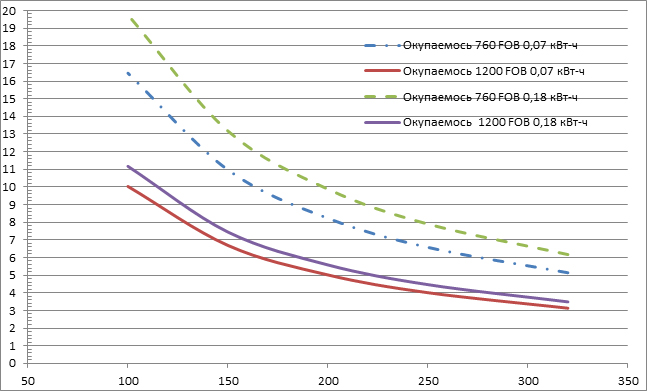
The Y – axis, months the X axis is days of operation with a full load in a year
The calculation is made as a guide, it does not address:
other operating costs (except electricity);
calculation of energy consumption, accepted estimates of 13.57 KWh, although in real conditions the measurements show 10-11 KWh, but does not include the electricity consumption by an additional shipment, which will be different in each layout.
not taken into account the impact of VAT (refundable upon export) on the final profitability (domestic prices include VAT);
not taken into account additional revenues from the sale of meal;
the individual specificities of the manufacturer, which can improve the final figures:
deep processing (refining)
packaging
own retail sales;
The cost of implementation (inclusion in the technological scheme) are estimated very roughly and may vary depending on the specific object and quantity of the beater-separator.
Please note the above information and invite you – technologists, producers, heads of enterprises, for an expanded discussion of this solution and the possibility of applying it to your production capacity. For all questions related to the work of SL-40, but specialists of our plant, we recommend you contact the Director of CPI "Vector" Alexander V. Alexandrov on the initiative of which the plant was mastered the production of SL-40.
Materials:
[1]. "The loss of oil in the husk are determined by the content in this oil, which depends on the Botanical oil content of sunflower husk, husk of oiling in rosilina-winnowing the shop and takeaway. the kernel husk. Botanical oil content of the husks is the lipid content of the husk in whole, intact sunflower seeds. The seeds vysokomolochnye varieties of Botanical oil content of the hulls increases with the growth of the total oil content of seeds is 1.8-2.5 percent. An oil-soaked husk is an increase in the lipid content in the husk. The reason of oiling - the absorption of oil husks (sorption) in contact with her fragmented nucleus seeds in the processes of hulling, when sieving on the sieves, during transportation of rosanky."
V. G. SHCHERBAKOV, the TECHNOLOGY for producing RASTITELNYI OILS, MOSCOW, KOLOS, 1992
[2]. "Maltobiose enterprises in the processing of modern varieties of sunflower seed faced the problem of high (up to 5 % and more) loss of oil from the waste husks. Irretrievable losses of oil with the husks consist of the following: Botanical oil content, obkalyvanija husk at harvest, during transportation, damage to seeds by obrazovaniem peelings in areas of cleaning, drying and storage, as well as in the processes of hulling and separation of rosanky, the removal of kernel in the husk, including particles of the nucleus, fused with the husks. In addition, hybrid sunflower seed is no gap between the husk and the kernel, and the elasticity of husks increased. As a result of processing such seeds bad fall in the towpath of the Huller and the husk waste is observed an increased content of particles of husks, fused with the core particles."
V. derevenko, Ph. D., Professor, head. the Department of PIAP, Y. Y. Tkachenko, "Kuban state technological University"; G. A. Glushchenko, LLC "ekotekhprom"
WAYS to REDUCE OIL LOSS WITH HULLS WHEN PROCESSING SUNFLOWER SEEDS, NO. 10 /2012 OILS and FATS
[3]. "Recently cultivated early maturing varietal and hybrid sunflower seeds with high oil content. New varieties of sunflower significantly changed the chemical composition of the kernel, changed the ratio of hydrophobic (fatty) and hydrophilic (nairboi) of the core. Sunflower seeds, although they have become smaller, but become more oilseeds and less musictime. The average lesistost seed is 23-26%. They have a thin, tightly adjacent to the core of the husks, the air gap between the core and the husk is almost nonexistent, therefore the Botanical oil content of the husk was increased to 2.85 and 3.2%. Increased percentage of nitrogen-free extractives and ash. Such morphological features in the structure of sunflower seeds complicate the process of hulling. Worsens the process of separating the husk from the kernel"
"There were analyzed the main quality characteristics of 30 samples of seeds, kernel, meal, husk, taking into account their physico-chemical and technological characteristics of... Was chosen for two plants in each region..."
|
Name of the indicator |
Peresechansky MEZ |
Prikolotnyanskiy |
||||
|
seeds |
the core |
meal |
seeds |
the core |
meal |
|
|
Arnosti, % |
3,28 |
1,33 |
1,33 |
3,99 |
0,82 |
0,82 |
|
Humidity, % |
5,34 |
4,96 |
8,47 |
4,17 |
3,54 |
10,78 |
|
Lesistost,% |
24,50 |
Of 10.56 |
Of 10.56 |
25,44 |
6,84 |
Of 6.81 |
|
Oil content,% |
48,12 |
52,10 |
1,40 |
47,95 |
56,17 |
1,54 |
|
Protein, % |
15,30 |
16,87 |
36,67 |
15,63 |
17,10 |
Of 38.45 |
S. L. EVTUSHENKO, the INFLUENCE of QUALITY INDICATORS of RAW materials AND TECHNOLOGICAL PROCESS ON the CONTENT of PROTEIN IN SUNFLOWER SEEDS AND PRODUCTS of ITS PROCESSING
VISNYK OF NTU"HP" №3 2008
[4]. "...Based on these data, we can conclude that the Ukrainian F1 hybrids NK Brio air layer is extremely thin, and the Jaguar F1 hybrids, NK Delfi, and absent. Reduction, and especially the absence of the air gap significantly affects the ability of seeds for structural collapse. This leads to an increase in the number of husks, difficult to separate from the kernel when shelling. This entails the removal of the husk to the kernel, and thus in its products - cake and meal; the deterioration of their quality indicators."
S. A. TESLENKO, E. P. URUKALO, L. I. PEREVALOV, ESPECIALLY HULLING SUNFLOWER HYBRIDS IN the FROZEN STATE, VISNYK NTU"HP" No. 14 (1123) 2015
[5]. "There is a lot of sunflower varieties with different seed sizes, thickness and mass fraction of husk. By breeding all the time there are new varieties. Breeding aims to increase oil content in seeds, often with a simultaneous decrease in the share of husks. This at first glance might seem to be a positive thing for technology obroski and eliminate the husks. Unfortunately, in General we can say almost the opposite — the more oil contained in the seed (and thus smaller proportion of husk), the more difficult to bring down such seeds. The results of the study of the properties of the husks, in particular the characteristics of obroski, published in many scientific papers, for example in the article Beaiigiiillaurae A., Architecture des coques de tournesol — OLEOSCOPE, Bulletin du CETIOM, 1982, n 8, 20-21 7/42. The author has substantiated that the husk formed by two types of formations of cells. Depending on grade, the ratio changes of the two types — one of them expressively contributes to the peeling (i.e., the fact that the husk "bursts" with a strong voltage) and the other is not. The ratio of these two types of formations of cells in the husk determines, thus, the overall "obrushivaet". In the work of the Russian author E. P. Mishka "Technological equipment of enterprises of production of vegetable oils" (St.-Petersburg, GIORD, 2002) sunflower seeds are divided into 3 types:
This third type is characteristic of sunflower varieties with high oil content. Was marked by a rectilinear dependence between the "obrushivaetsya" and the size of the seeds (the more seeds the easier it is for them to bring down). From this it follows that the best results are achieved from seeds of large and, most importantly, the same size (the size of the seed determines the choice of sit in sorting devices). In the processing of "bad precipitates" of sunflower seeds, there is a reduced abrusci — increasing proportion of husk in the fraction of kernels and oil content of the husk"
the seeds of the first type, the husk is broken into 2-3 large pieces and is easily separated from the nuclei;
seeds of the second type, the husk is broken into 6-8 pieces and remains in the nucleus;
the seeds of the third type, the husk is broken into many parts, most of the husk remains in the nuclei, and moreover the kernel when obruchka fall to pieces.
Obruchka and separation of husk http://farmet.com.ua/?page_id=210
[6]. "A small air cavity between the core and the shell are characterized by hybrids of sunflower seeds. They also have small dimensions. The mass of 1000 pieces of seeds of hybrids (especially the old selection) ranged PA 50-55gr vs 65 to 70 g in cultivars populations. In the hybrids of the old selection air cavity between the core and the shell were absent. Many hybrids seed husks fused with the nucleus and separates hard when shelling.
Experience of processing of seeds of sunflower in production conditions shows that the hybrids seeds fall by 15-30% worse than grade population. It degrades the quality of rosanky, increases the content of integers and nedovrseni seeds, broken rice and oil dust, and, as a consequence, leads to increased losses of oil from the waste husks."
Shazzo L. A., KTN, United Gurusharan A. P., KTN, United Mkhitaryan L. A., KTN, "Kuban state technological University"
MODERN ENGINEERING AND TECHNOLOGIES OF PROCESSING OF SEEDS OF SUNFLOWER OF MODERN SELECTION
[7]. The seeds of the oilseed. Methods of determining oil content. GOST 10857-64
[8]. Aleksandrov A. V., General Director of CPI "Vector" Innovative solutions in the extraction of oil, "oil and fat complex" № 1(44) March 2014
Feed back